PAID ACQUISITION
How to Calculate Returns-Aware Break-Even ROAS
Translate mature-cohort return behavior into the maximum ad spend a product can support.
- Published
- Reviewed
DIRECT ANSWER
The calculation in one paragraph
Returns-aware break-even ROAS equals retained revenue divided by the maximum ad spend that remains after expected non-ad variable costs and any target contribution. Model return behavior with a mature cohort: a high apparent ROAS can still lose money when refunded revenue, retained fees, reverse shipping, and unrecoverable product are included.
Open the break-even ROAS calculatorUse settled or mature-cohort inputs
Advertising platforms report attributed revenue on their own windows, while returns can arrive after the sale. For a decision about paid acquisition, measure a cohort old enough to have substantially matured through the normal return window. Match ad spend, orders, refunds, and costs to the same channel and period.
Do not assume every return costs the selling price plus all original costs. Record what is refunded, which payment or marketplace fees are retained, how much product cost is recoverable, and the average reverse-logistics cost. These are policy- and category-specific inputs, not universal constants.
Find the spend available after non-ad costs
First estimate retained revenue after expected returns. Then subtract landed product cost, transaction fees, fulfillment, shipping subsidy, expected reverse-logistics loss, and any other per-order cost. The remainder is the maximum advertising spend at break-even before fixed overhead and target profit.
ROAS is revenue divided by ad spend, so it rises as allowable spend falls. State which revenue measure is in the numerator: gross attributed sales, net retained sales, or a modeled expected value. Comparing a gross ROAS target to a net-profit calculation is a common source of false confidence.
Set a guardrail, not a guarantee
A break-even threshold has no room for attribution error, cash timing, overhead, stockouts, or a further return-rate increase. Set a target contribution margin above break-even and test higher return, fee, and shipping scenarios. Use the same definition in campaign reporting so the team does not optimize toward a different number.
Review the threshold whenever return policy, assortment, shipping offer, creative, or platform fees change. If the calculated available spend is zero or negative, paid acquisition cannot be made profitable through ROAS alone under the stated inputs; validate the data and review the product economics.
WORKED EXAMPLE
Expected-value campaign
- Customer price: $100
- Expected retained revenue after returns: $88
- Non-ad variable costs: $48
- Target contribution: $8
Allowable ad spend = $88 − $48 − $8; ROAS = $88 ÷ $32$32 maximum ad spend; 2.75 net-revenue ROAS targetUsing gross $100 revenue in the numerator would create a different metric and must be labelled.
Return-cost checkpoints
| Item | Question |
|---|---|
| Refunded revenue | Is it measured from a mature cohort? |
| Product recovery | What share returns to usable inventory? |
| Fees and reverse logistics | Which costs remain after a return? |
Download and visual reference
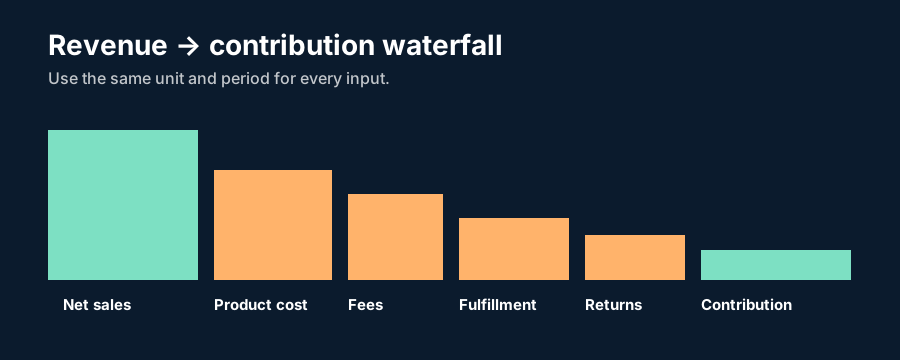
A practical workflow
- Choose a mature customer cohort and matching ad spend.
- Estimate retained revenue and expected return loss.
- Subtract all non-ad variable costs.
- Reserve the target contribution before assigning ad spend.
- Convert allowable spend into a consistently defined ROAS target.
EDGE CASES
Frequently asked questions
Can I use platform-reported ROAS?
Use it as an attribution metric, but reconcile it to a consistent net-revenue and return-cost view for profit decisions.
Is break-even a campaign target?
Usually no. It leaves no allowance for uncertainty or fixed costs; choose a target that retains the contribution your business needs.